Project Timespan
Spring of 2018
Inspiration
Several previous Clog entries have focused on The Adventures of Tintin, a Belgian comic book series of which I am a particular aficonado: The Common App, Revisited, in which I used the author of the series, Georges Remi, as inspiration for my college application essay; Me, the Tintinologist, a series of porcelain sculptures that I made concurrently alongside this larger project; and Snowy Doorbell Cover, a functional door display that hangs on my apartment door. In the near future, I hope to also cover a project entitled, “Tintin in Queens,” in which I constructed a Little Free Library from discarded materials.
This particular work encompasses several months of work in the spring of 2018. Ostensibly, I worked normal business hours as a research fellow on campus, but each day I found myself spending hours after work in the ceramics studio.
Project Overview
Now, the process of making these Tintin figurines is analogous to what I have already covered in the clog Me, the Tintinologist. Therefore, I will try to stay clear of repeating the steps of making the base sculpture (i.e. 3D-printing the mold, plaster casting, slip-casting) and focus more on the details of the sculptures themselves. Let’s just fast forward to that portion, and those who are interested in the mold-making process can consult the other clog linked above.
I also made a video of each of the Tintin sculptures with 360-view using a rotating base. The background music is from the 2011 The Adventures of Tintin film.
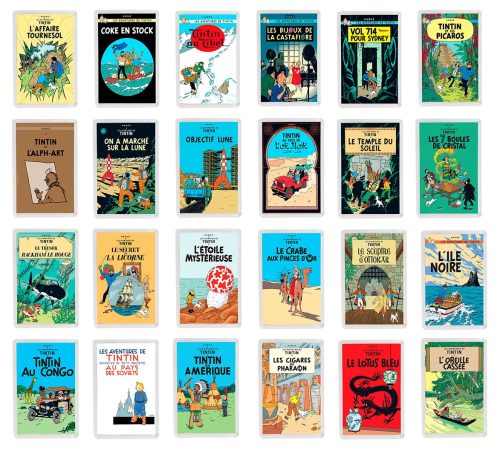
24 Tintin Comic Albums
Officially, there are 24 Tintin albums with the first (Tintin in the Land of the Soviets) published in 1929-1930 and the last (Tintin and Alph-Art) published posthumously in 1986. Throughout these works, Tintin finds himself embroiled among criminal syndicates and arcane mysteries, aboard submarines and space rockets, and visiting countries both familiar and foreign.
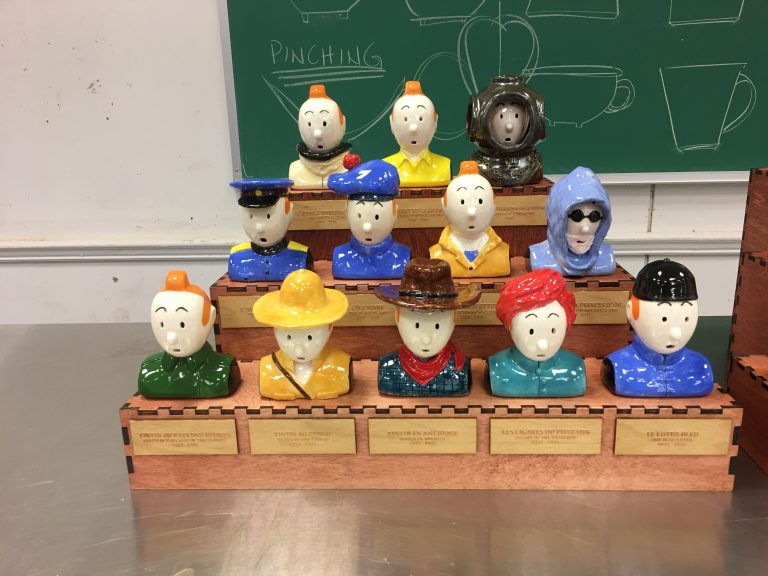
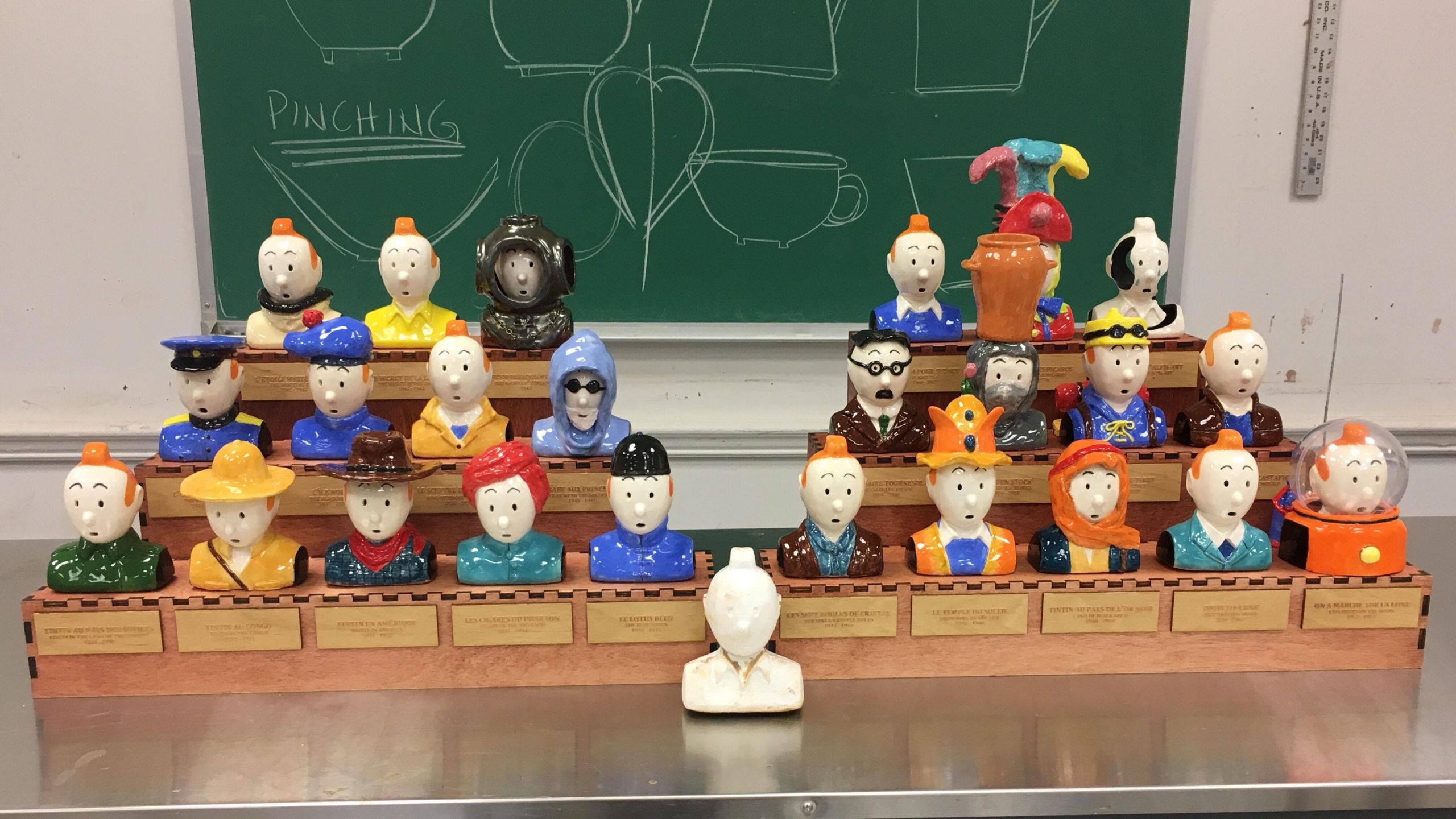
While Tintin is often depicted in his classic light blue collared sweater and cropped trousers, he takes on numerous guises over the course of his adventures. I decided to choose an outfit representing each comic album. Below are the outfits in chronologic order by comic album.
Tintin in the Land of the Soviets (1929)
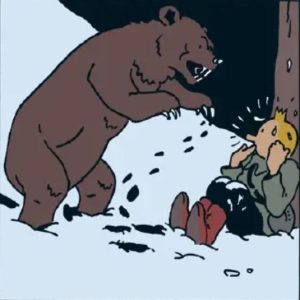
It took many decades for the first Tintin comic album to even be colorized. In this album, Tintin wears several exotic outfits, including one with an ushanka, one in a blue uniform with a red sash, and one in a diver’s suit. In hindsight, I should have chosen the ushanka Tintin, but I chose another with him in a gray-green army uniform.
The final color of the porcelain turned out to be a touch too green, but it contrasts well with some of the other Tintin sculptures in the final display.
Tintin in the Congo (1931)
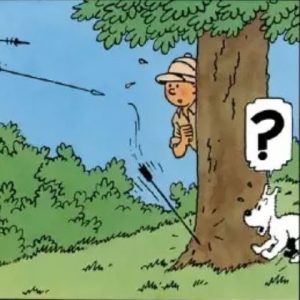
Tintin in the Congo is probably the most controversial comic album of them all for its frankly racist, colonial depiction of the Congolese. A bold choice would have been to depict Tintin wearing a skin suit of a chimpanzee that he had shot, but that would be in poor taste. I settled on Tintin with his pith helmet, which features prominently in the comic album.
The end result was, once again, somewhat off in color (not enough beige). There are also small details in the hat, including fold lines and a small pip at the top that I failed to capture.
Tintin in America (1932)
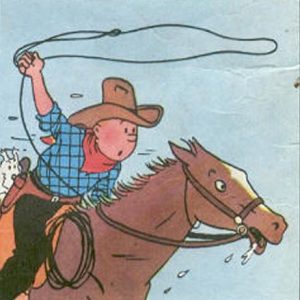
Tintin travels to yet another continent in the third escapade of the series. Many Tintin album collections forego the first two albums and start with Tintin in America, given some of the questionable depictions of the previous two works, but this album also runs afoul of stereotyping Native Americans. That being said, Tintin in America features one of Tintin’s more distinguished guises in form of a prototypic American cowboy.
My favorite aspect of sculpting this Tintin was including the quilted texture of the shirt and the contours of the cowboy hat.
Cigars of the Pharaoh (1934)
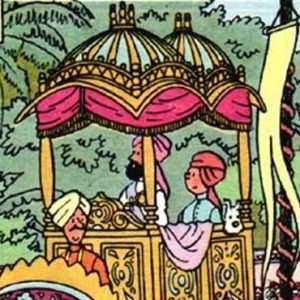
Cigars of the Pharaoh feature Tintin in a few memorable outfits. For example, he wears a keffiyeh in the desert, a prisoner’s straitjacket, and a purple cultist’s hood and robe. While these are all reasonable options, I chose to depict a scene towards the end of the album, with Tintin in a red turban as he sits atop a palanquin borne by an elephant.
Two aspects of the figurine that I appreciate the most are the folds of the turban and the color of the sherwani jacket.
The Blue Lotus (1936)
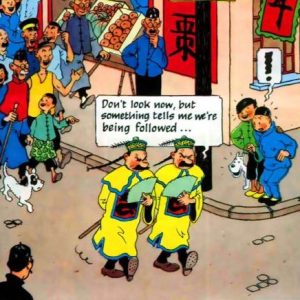
Hergé took great pains in research for the creation of The Blue Lotus, and his depictions of Chinese society were much lauded by contemporaries as well as modern-day audiences.
Tintin wears a blue changshan and black skullcap for much of the story, and it was the obvious choice to sculpt him in this traditional attire. That being said, the matching garish looks of Thomson and Thompson are hard to beat!
The Broken Ear (1937)
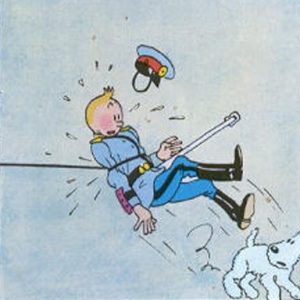
Tintin cycles through a few outfits over the course of this adventure, but the one that stands out is Tintin in a blue colonel uniform with smashing yellow shoulder boards.
Inspecting the sculpture carefully, with the benefit of hindsight I see that I forgot to add in the chin strap for the hat!
The Black Island (1938)
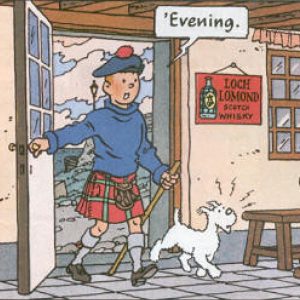
Tintin travels to Scotland to pursue a gang of counterfeiters. When in Scotland, one must don a kilt, tam o’shanter (with toorie), and a walking stick. Tintin looks the part and even partakes in Loch Lomond whisky at the local tavern, though he stops short of toting a bagpipe.
I was quite fond of the way this sculpture turned out, especially the process of fluffing up the red toorie on the top of the hat.
King Ottokar's Sceptre (1939)
Surprisingly, though Tintin travels all the way to Syldavia and foils an attempt at a coup d’état, his wardrobe is limited to a tan overcoat over a brown suit jacket. I opted to include the overcoat during the sculpting process.
Not much to elaborate here on the sculpture. Straightforward and simple.
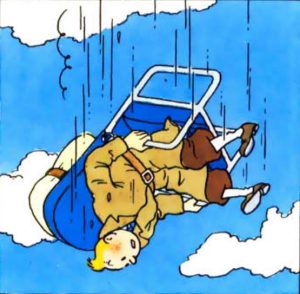
The Crab with the Golden Claws (1941)
Captain Haddock, inebriated with whisky, makes his first appearance in this comic album. Under the unrelenting desert sun, the trio of Haddock, Tintin, and Snowy make a memorable trek before the conditions overcome them. Upon rescue, Tintin wears a stylish white bowler hat. Instead of this outfit, I chose one of Tintin dressed in beggars’ rags outside a mosque.
Most of Tintin’s facial features are hidden by the makeshift white beard. Combined with the black glasses, Tintin is almost unrecognizable
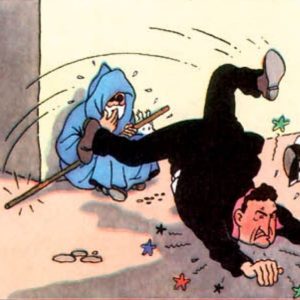
The Shooting Star (1942)
Tintin embarks on a race to land on a meteorite that has landed in a remote portion of the Arctic Ocean. Given the harsh, cold climate, the characters aboard the ship must wear many protective layers, and Tintin is seen in multiple parkas and heavy jackets.
I selected the black-fur-lined overcoat for Tintin’s outfit, and while the sculpture turned out well, I missed the opportunity to add the parachute cords over his shoulders and back.
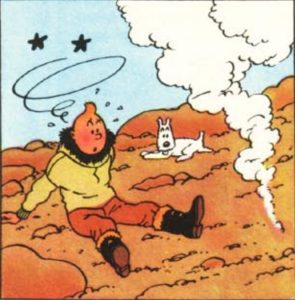
The Secret of the Unicorn (1943)
The Secret of the Unicorn is the first of a two-story arc and was adapted by Spielberg as The Adventures of Tintin in 2011. Most Tintinologists view these two works as among the best in the series, and Hergé himself considered them among his favorites.
While Captain Haddock, or rather, his ancestor Sir Francis, is seen clad in a mauve sailor’s outfit as he duels the deadly Red Rackham, Tintin chooses comparatively tame attire. He almost hides within a suit of armor – that would have been fun to sculpt – but instead I had only the yellow shirt and tan overcoat from which to choose. I opted for the former as the latter was already used.
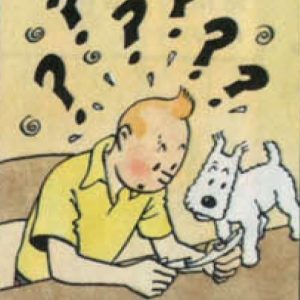
Red Rackham's Treasure (1944)
Where is Red Rackham’s treasure? The second half of this thrilling adventure takes a deep dive into solving a centuries’ old mystery.
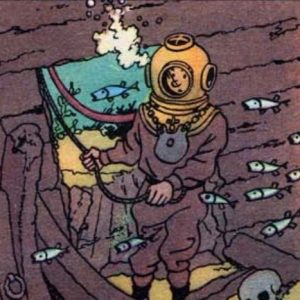
Tintin in the diving suit was perhaps the most technically challenging figurine to sculpt of the series. I did not sculpt the chains but rather added actual metal chains after the piece was glaze-fired and otherwise complete. What sets the finish of this model apart from the others was that I could not simply spray the entire model with clear glaze, as the metal of the suit required painting on a specific metal-finish glaze. The clear glaze I then brushed on to Tintin’s head, sticking the brush through the openings of the helmet.
And that marks the halfway point of the Tintin albums. Here is the first half of the collection:
The Seven Crystal Balls (1948)
This comic album has one of the scarier characters in the series with the awakening of a sacred Incan mummy – or was it all a dream? Early on in the comic album, Haddock finds himself wearing a theatre cow head that falls upon his head, and later in similar slapstick, Snowy runs afoul of a metal helm; Tintin, however, wears only his usual outfits with the exception of sooty pajamas. Alas, I missed that opportunity.
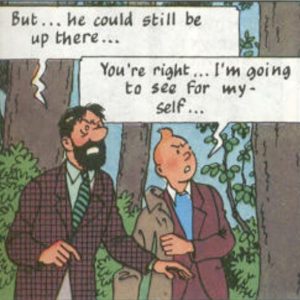
Tintin wears the brown suit jacket only briefly in the album, and I both botched the color of the sweater and painting the white collar. Whoops!
Prisoners of the Sun (1949)
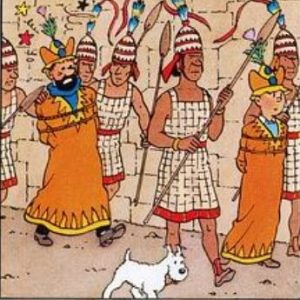
There are some excellent outfits from which to choose in Prisoners of the Sun. Early on, Tintin wears a striped punchu and a variant chullo hat, but it is the sacrificial robe, or so-called “Patagonian petticoat” that I chose to depict.
The resulting figurine is one of the most striking in the collection, though in hindsight I think I would have skipped sculpting the flower and instead modeled it after the fact, as it turned out to be extremely delicate and fragile.
Land of Black Gold (1950)
There are two competing outfits to consider in the Land of Black Gold. The first depicts Tintin wearing an orange keffiyeh, and the second shows Tintin disguised with black glasses and a red cap. I wanted to practice sculpting the folds of the outfit, so I picked the former option.
The finished sculpture is a nice, compact shape and is reminiscent of the turbaned Tintin from Cigars of the Pharaoh.

Destination Moon (1953)
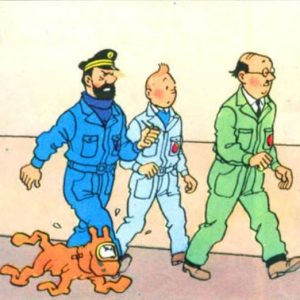
The first of a two-part story arc, Destination Moon shows Tintin in a couple of distinct outfits, including an all-orange anti-radiation jumpsuit and a light blue astronaut’s uniform. At this point of the project, I must have been running out of steam, for I chose the less interesting of the two options (though maybe I chose the astronaut uniform for better color contrast, who can remember?).
In the accompanying comic still, Snowy is clad in the anti-radiation jumpsuit – another opportunity missed!
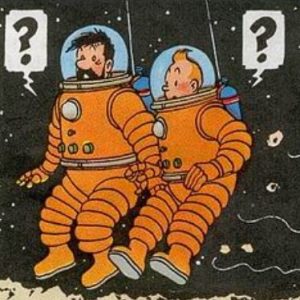
Explorers on the Moon (1954)
Only one viable outfit comes out of the Explorers on the Moon comic album: that of the astronaut suit itself. The most challenging aspect of the sculpture was to come up with how to depict the glass helmet. In the end, I found a two-part plastic sphere online; after cutting out the bottom segment, it sat perfectly within the circular indent of the suit collar. Using thin wooden dowels, I then added the antenna to complete the look.
The Calculus Affair (1956)
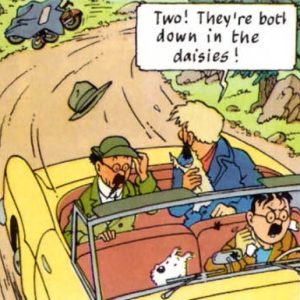
In The Calculus Affair, Captain Haddock and Tintin pose as International Red Cross representatives to whisk away Professor Calculus from captivity. They embark on a high-speed getaway that involves switching to a well-placed getaway tank!
The most fun part of sculpting this disguise was to change the shape of Tintin’s eyes, which helps sell the effect of high-powered spectacles.
The Red Sea Sharks (1958)
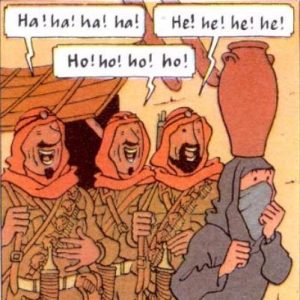
The Red Sea Sharks take place amidst the waning years of the Red Sea slave trade. Tintin and Captain Haddock once again take on disguises, this time to bypass a group of soldiers on patrol. The two of them each precariously balance a pitcher on the top of their heads, but in advance they use up the entirety of a merchant’s supply to practice the balancing.
I had wanted to use a throwing wheel to make the pitcher, but my skill level wasn’t there to make a good job of it, so I resorted to using hand-building techniques instead.
Tintin in Tibet (1960)
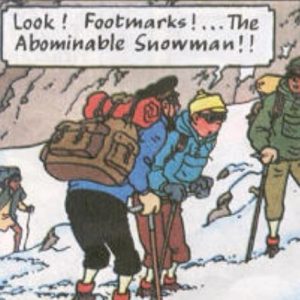
Tintin in Tibet is Hergé’s favorite of the series, and many fans applaud its emotional depth and magnificent storytelling as Tintin sets off in a desperate search for Chang Chong-Chen, a dear friend feared dead after a plane crash deep in the Himalayas.
I chose to depict Tintin with a full mountaineering backpack, and the final sculpture is my personal favorite of the project.
The Castafiore Emerald (1963)
Bianca Castafiore is one of the series’ most well-known figures, and her interactions with the gruff Captain Haddock are comedy gold.
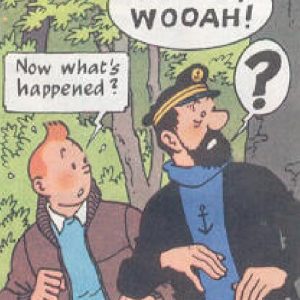
In this album, Tintin and company find themselves cooped up within Marlinspike Hall itself. As such, there wasn’t much to choose from by way of outfits; I sculpted a brown bomber jacket over Tintin’s existing collared-sweater attire.
Flight 714 to Sydney (1968)
I have never found Flight 714 to Sydney to be a particularly compelling Tintin album. There isn’t a whole lot that goes on in throughout the album; fittingly, the is perhaps the only album in which there is but one depiction of Tintin – in his classic white-collared blue sweater.
The best part about making this figurine was that there wasn’t anything additional that I needed to sculpt!
Tintin and the Picaros (1976)
In this comic album, Tintin travels to a fictional Latin American country in the midst of revolution, blending together Cold War geopolitics with guerilla warfare à la Guevara. Although handled somewhat heavy-handedly, the comic album has its moments of levity that make it a memorable piece of the oeuvre.
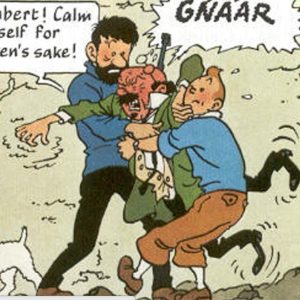
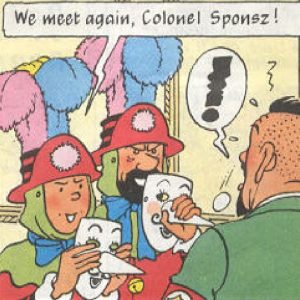
Leading up to the climax of the album, Tintin and Haddock don carnival-style outlandish garb to infiltrate the headquarters of General Tapioca.
Sculpting this Tintin model was one of the more entertaining aspects of the project – it’s quite top-heavy!
Tintin and Alph-Art (1986)
The last of the Tintin comic albums, Tintin and Alph-Art, was published posthumously. Different versions of the album exist, and it is the only album that I have not personally read in its entirety.
I ultimately decided not to select any particular outfit, but instead sculpted an unfinished version of Tintin to symbolize the the unfinished comic album itself. I also depicted a couple of tears running down Tintin’s cheek in remembrance of Hergé.
And here is the second half of the collection:
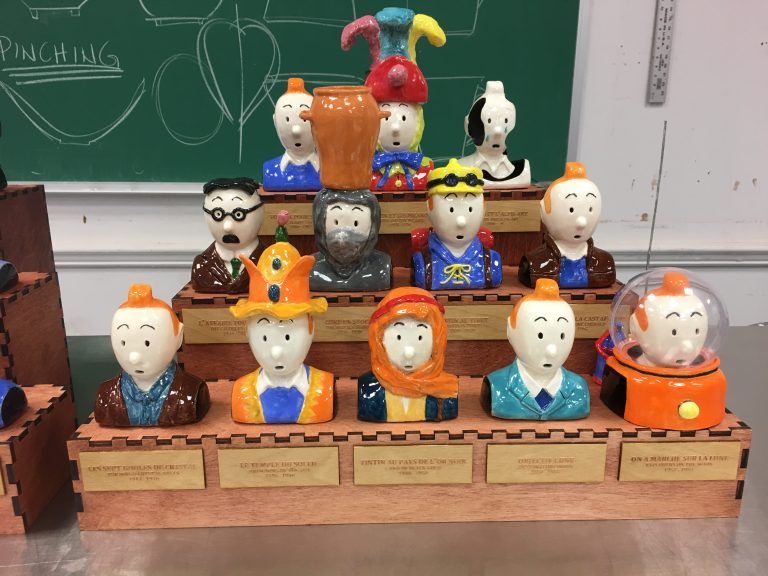
Finishing Touches
Firing and Display Plinth
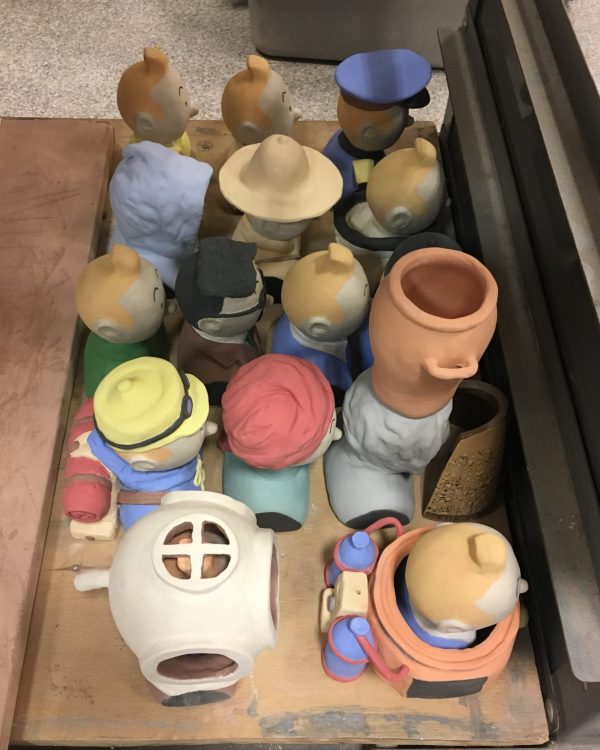
After sculpting details and bisque firing, I painted in Amaco underglazes. I then sprayed each figurine with clear, gloss-finish glaze.
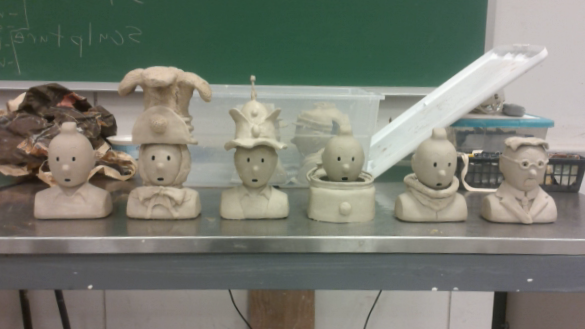
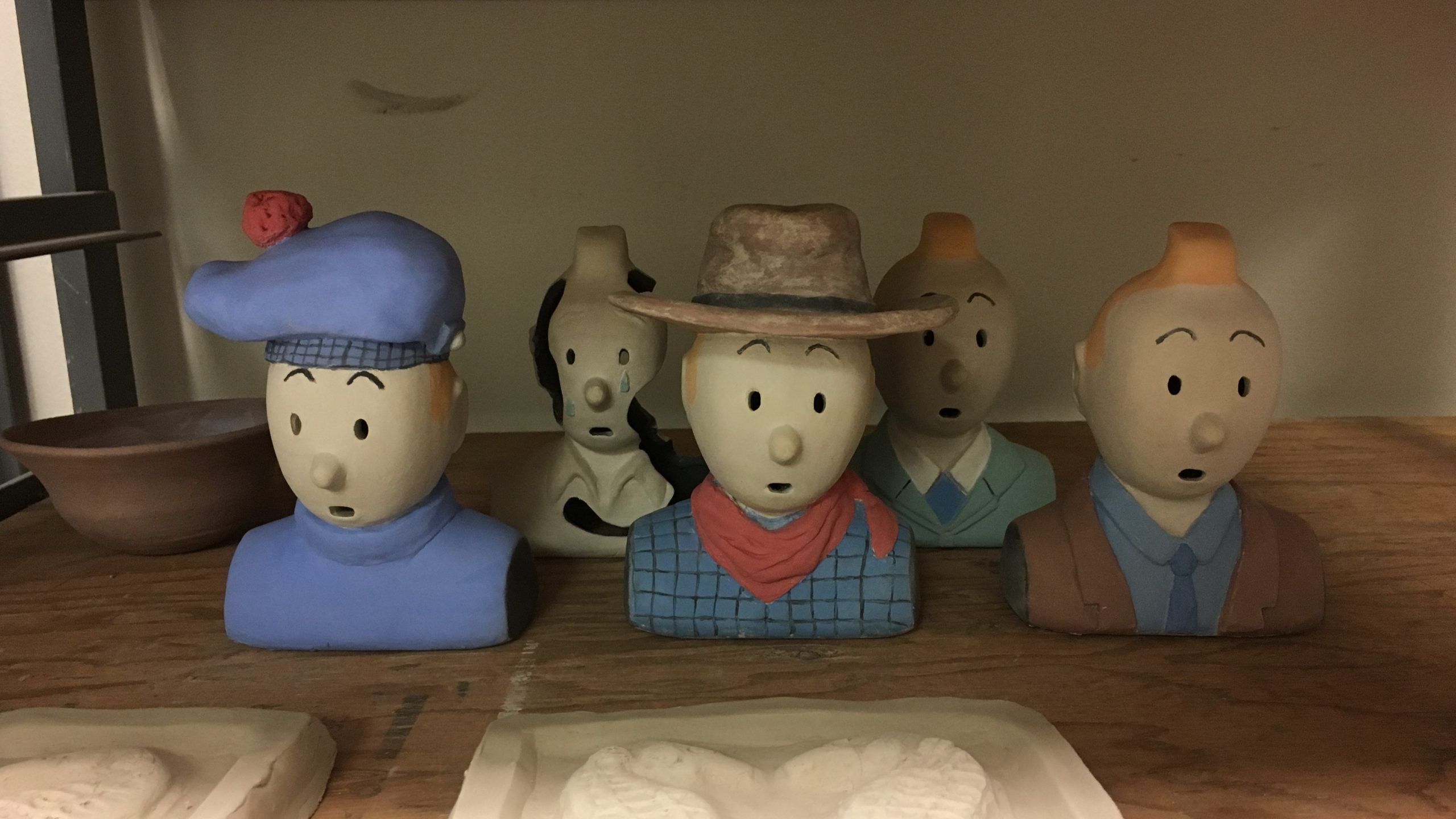
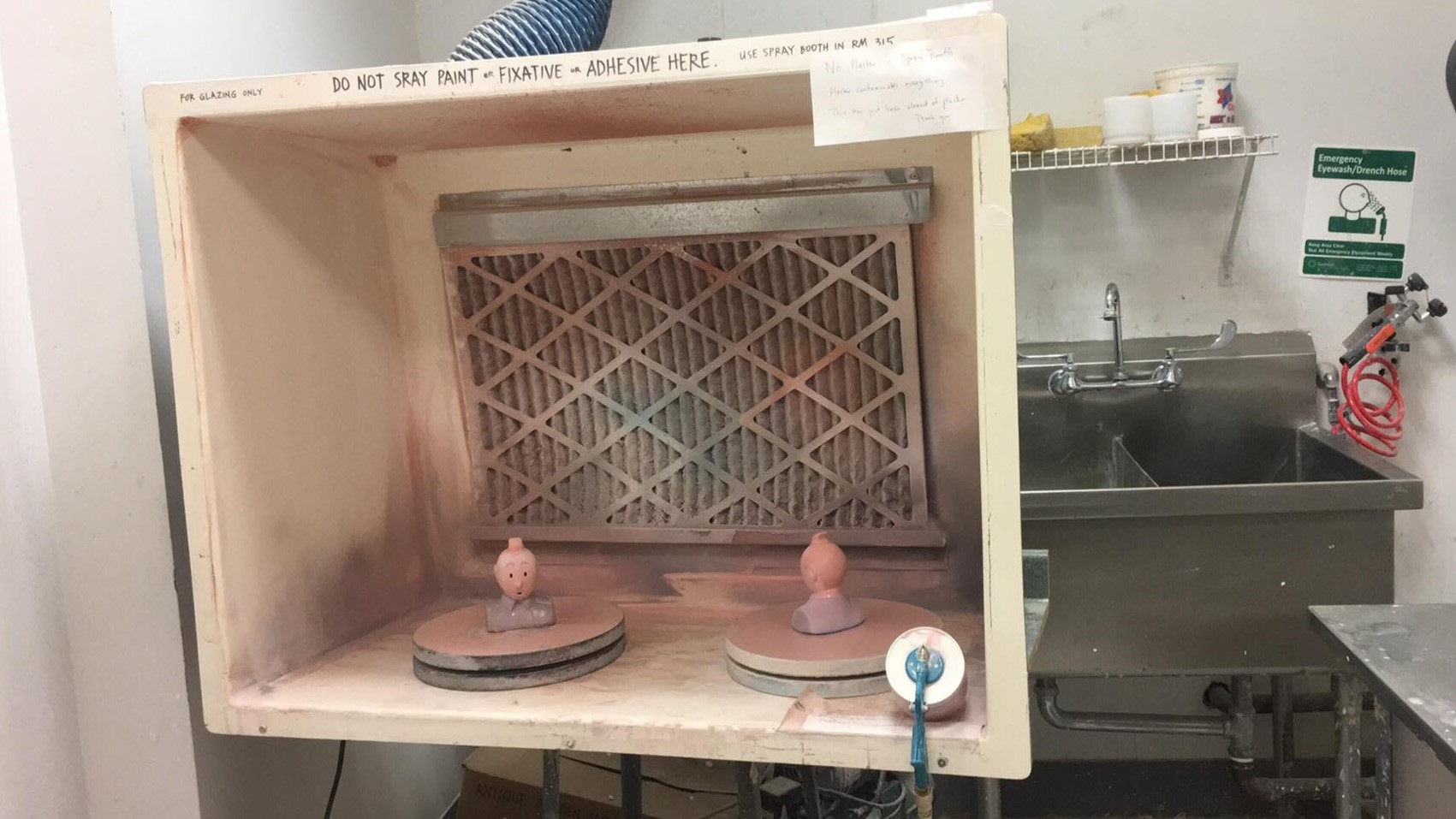
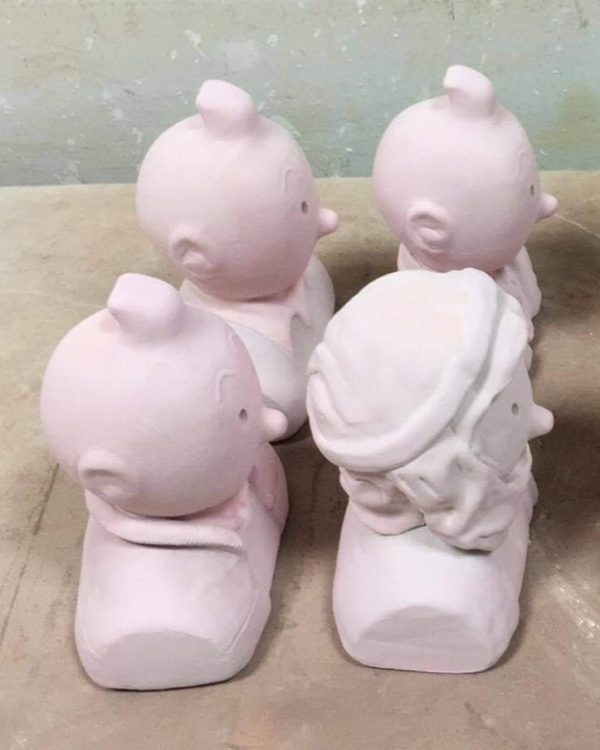
The ceramics studio had a separate room in which one could use a spray gun for the gloss finish. This made it much more consistent to apply to the figurines. When dried, the figurine gained a light pink, chalky texture. As they say – trust in the process. Once glaze fired, the pink layer transitions into a glossy, clear finish. The only model that I did not glaze was the diving suit Tintin. For that one, there was a special “metal” glaze that I painted on directly to the bisque-fired porcelain. The effect is incredible!
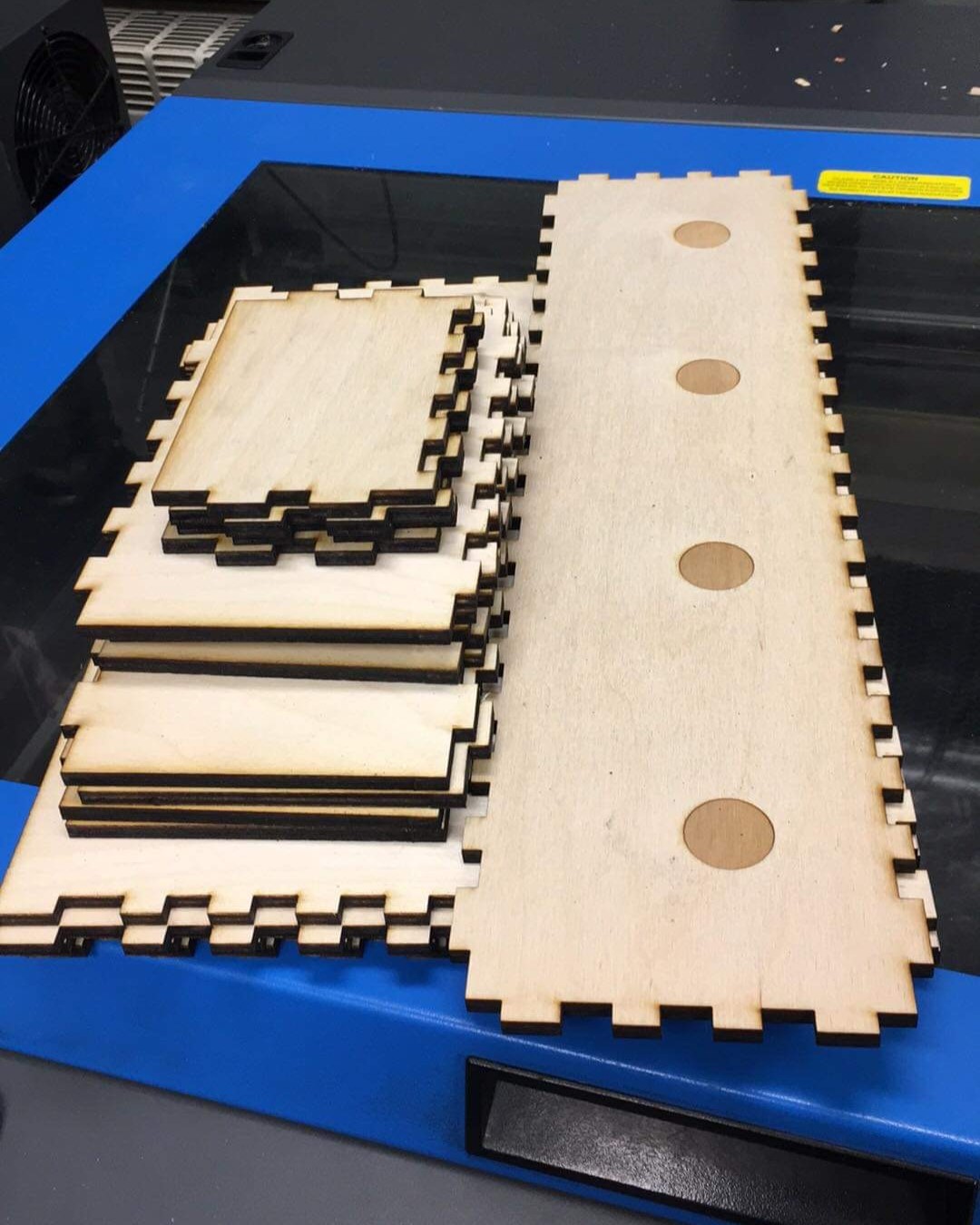
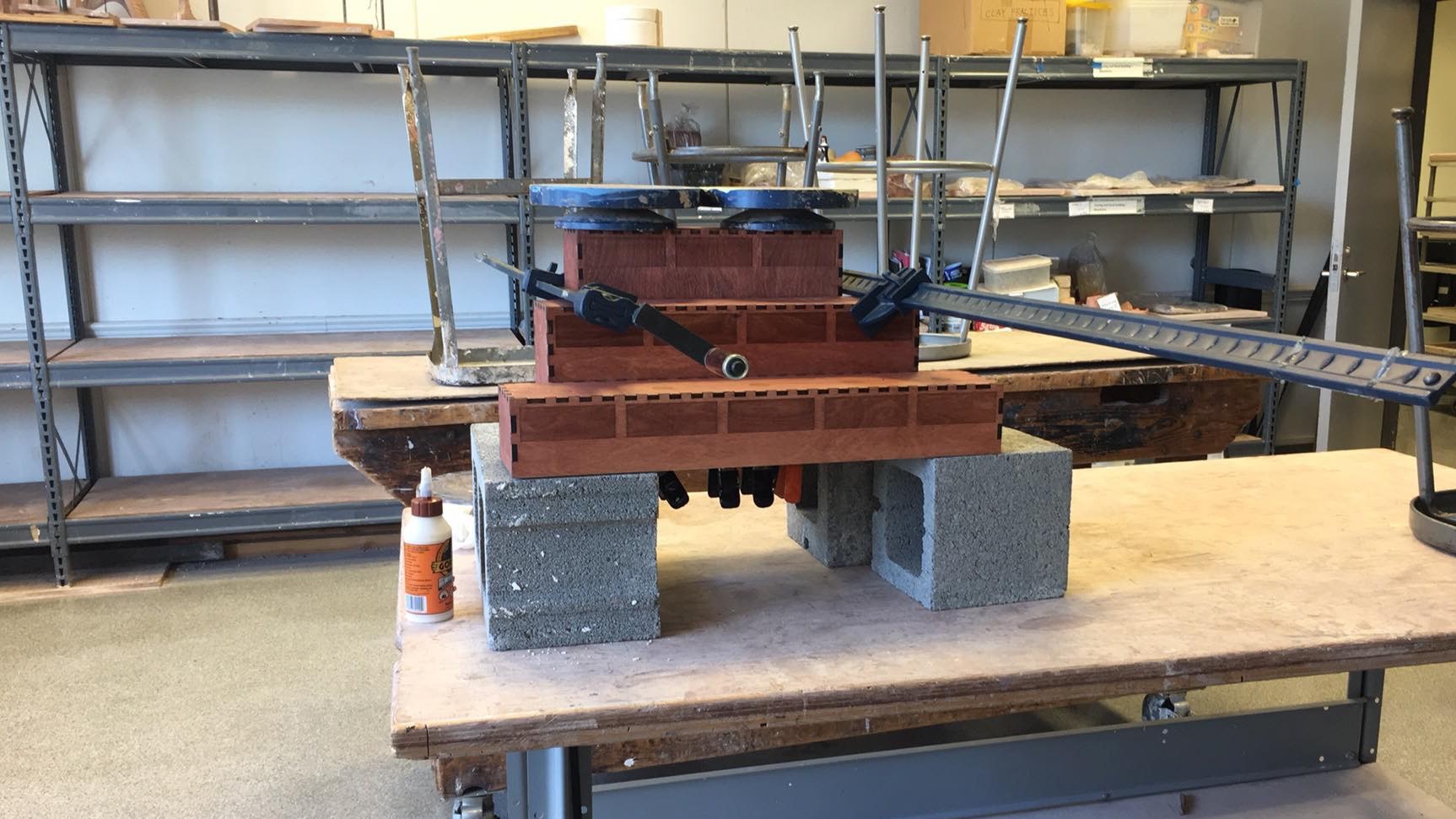
In the meantime, I whipped up a laser cutting design for the display plinth. I settled on a making a pair of three-tiered plinths that would fit 12 figurines each. Constructed of 1/4″ Baltic birch plywood with box joints, the plinths were more than sturdy enough once glued together. The design had shallow indents for 1″ wood dowels that would fit within the underbelly of the figurines for stability. Each figurine would also be accompanied by a display label with the title of the Tintin album in both English and French along with the respective year(s) of serialization.
Lessons Learned & Improvements
Over the course of countless hours spent sculpting the figurines, I improved my ceramic hand building skills considerably. I am most proud of the “metal” diving suit in Red Rackham’s Treasure and the mountaineer backpack from Tintin in Tibet; on the other hand, I wish I had the time to revisit Tintin in Tibet, which literally sags with disappointment.
Looking back at the collection as a whole, I point to the following technical choices:
1. Unpainted faces: I chose to leave the Tintin faces unpainted as I wanted to highlight the natural porcelain color underneath, but part of me wonders if that was the correct choice from an artistic standpoint.
2. Painted figurines: alternatively, part of me wonders if I should have simply left the figurines sans color completely!
3. Ligne claire: Hergé was famous for his “clear line” style with precise black lining of details. I opted not to go for this look, partly out of apprehension of the execution.
4. Consistency: The astute observer will have noticed that some Tintin figurines look more down or up than others, his hairline is not perfectly uniform, and his eyes are not all the same shape. One could chalk this all up to the perfect imperfection of human hands, but I always strive to reduce my mistakes.
5. Standalone bases: The figurines sit on display in my family home in Wisconsin, but I would have been a smart choice to make a few portable display bases for select models. I may revisit this idea in the future.
6. Bolded display labels: The contrast between display text and background color is lacking, making it hard to discern the comic album titles and dates. Choosing a darker stain or painting in the text post-hoc are good solutions.
Reflection
The best projects are the ones that one looks back upon with nostalgic fondness. These are the projects that are driven by passion and passion alone, in which time spent matters naught, for the gratification of the work itself is without price.