Inspiration
I was on a flight from the Southwest US back to good old JFK, and I was in desperate need of staying productive. As Benjamin Franklin once said, “You may delay, but time will not, and lost time is never found again.” And so I decided to boot up the computer and start free writing.
Previously, I have also touched on the topic of “lost time” in this post entitled “On The Passage of Time.”
Note that the PDF version as attached below has slight differences (i.e. errors in punctuation and syntax) that I have amended forthwith in the post.
Wasting Time
The great science fiction writer Arthur C. Clarke once stated that “any sufficiently advanced technology is indistinguishable from magic.” Indeed, our modern life is filled with conveniences (that we take for granted) that would otherwise dumbfound even the most forward-thinking minds of centuries past. To highlight this point, I find myself typing this document using a laptop keyboard in Microsoft Word, thirty thousand feet in the sky, aboard an Airbus A321 en route from Phoenix to New York. Most would opine that these technological expedients, for lack of a better term, have streamlined our lives and offered an unparalleled amount of a priceless luxury – time.
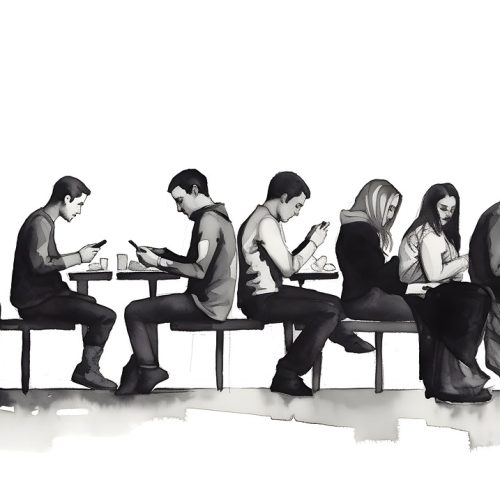
I include myself in this following condemnation, but it seems to me that a large part of modern man, holding a relative surplus of free time in comparison to his ancestors yet finds himself squandering that precious gift, as billions of hours a day are spent doom scrolling the latest fads on X, Y, or Z social media platform. Our attention spans have become measurably shorter as we find ourselves drawn to the nearest flickering screen. In short, technology has molded us to become both as productive and unproductive as we have ever been.
It would be remiss not to continue to mention my own hypocrisy throughout this document. This morning, a banner notification on phone indicated that over the past week I had spent six hours a day using the device – much of it no doubt taken up by those 30-second YouTube shorts that accumulate to hours down the drain.
Sometimes, I wonder how Leonardo da Vinci, the prototypic renaissance man, would turn out if he found himself growing up in our modern world. Would he take advantage of the intervening centuries of scientific advancement, or would the TikTok algorithms be too persuasive? For someone who unironically lamented on his deathbed that “[he] had offended God and mankind by doing so little with [his] life,” does that mean we all are living in offense to our own potential?
A further question then arises in my mind – “What defines a productive life?” I am sure that there are whole schools of philosophy that debate the essence of these questions, which themselves likely fall in the same general vicinity on the 42 Most-Asked Questions list as “What is the meaning of life?” or its companion “What happens after death?”
With regards to the initial question posited a paragraph ago, my thoughts drift to the excellent novel A Canticle for Leibowitz, set in a post-apocalyptic future of the 26th century. Brother Francis spends fifteen years painstakingly illuminating a copy of a “relic” manuscript from six centuries prior, only to eventually lose his life’s work (and life) to bandits during his journey to bring the tome to the head of his order.
While I chose this ahistorical work given a lack of personal knowledge of a specific real-world example, it takes little imagination to conjure up the image of a monk in medieval Europe performing the same task of illumination, year in and year out.
The capitalist within me would argue that productivity and potential can be measured objectively – words scribed per hour, pages scribed per day, chapters scribed per year; personal potential even may be measured in cruel mathematical formula as a ratio with output the numerator and maximum scribing rate the denominator – fatigue and cramping hands notwithstanding.
Indeed, fast-forwards (or backwards) to the present day, and our lives remain slaves to these metrics. The specific numbers or units differ per person and their respective industries – for my field it is the “relative value unit” – but at the end of the (work)day our worth is neatly summarized in accounting tables.
Looking back at my own arguments, I see a contradiction. Like an ass I quote myself: “Technology has molded us to become both as productive and unproductive as we have ever been.” But are we indeed productive if the whole endeavor was a waste of time? Does a salaryman working or commuting for nearly half their waking hours find it productive to increase the company’s bottom line by 0.0001%, or do only the board and shareholders reap the benefits?
Perhaps I am looking at this all backwards. Perhaps our true productivity, real productivity, is a big, fat zilch. For we are neither truly productive while at work nor at rest!
Now comes the rub – if we are minimally productive at work, how can we be truly productive in our free time?
As an aside, if you are still reading this document, I apologize for wasting so much of your time thus far (unless you are a fast reader, in which case I apologize less, or if you have gotten something out of this writing, however unlikely, in which case I apologize not at all).
I have rambled on long enough, in any case, that I think I should introduce my last thought: Art (capital A) is the essence of a productive life.
Through the sorcery of the World Wide Web, I can almost see your eye roll and hear your scoff. The way I see it, Art is the personal act of creation – a sentence so nebulous that mayhap it doesn’t mean anything at all to you. Perhaps it is a cop-out, wherein production and creation are nearly synonymous, but let’s break it down further.
Through the transitive property, let’s port in Art’s definition to form the following statement:
The personal act of creation is the essence of a productive life.
Art must be meaningful on a personal level – when one seeks commercialization or “production” at expense of meaning, one begins to lose the spirit of productivity. Now, it may be possible, a la Warhol, to blend the two tougher, but ultimately the judge of the truth is not the observer but oneself.
The beauty of this definition is its broad applicability. There is no objective hierarchy of artforms. If it is a personal act of creation – not passive consumption of spoon-fed media, mind you – it fits that definition of productivity.
While others may see a productive life circumscribed through the lens of output, output, and output, I find this viewpoint fallacious. True productivity altogether relies not on output but on Art – the personal act of creation – with personal meaning being the parameter.
So as this Airbus touches down to JFK airport, part of me can’t help but think, “Did I just waste two hours and change on this useless piece of writing?”
But then the wiser part of me chimes in, “No matter how useless, what a marvelously productive writing session!”
Reflection
I thoroughly enjoyed writing up this little piece. I had debated watching a movie instead of writing, but I was saved by a WiFi outage that directed me to go offline and tap into the creative juices.