Project Timespan
2017 – 2018
Inspiration
For the year after college, I spent a research year on campus, ostensibly working on liver and kidney transplant research but supplementing that education with one in board games. I learned the game of Hive, a two-player abstract game that has been termed as a modern-day version of chess.
Hive is a game in which the board is comprised of the game pieces themselves. At the onset of the game, the board is empty, and players take turns placing a piece upon the board or moving a piece already on the board. Pieces are hexagonal and consist of a Queen Bee (x1), Beetle (x2), Spider (x2), Ant (x3), and Grasshopper (x3). Each of the pieces has a unique movement style. There are a couple of expansions to Hive as well, adding in the Pillbug, Mosquito, and Ladybug. The goal of the game is to surround the opponent’s Queen Bee on all six sides with pieces (can be a combination of both yours and opponent’s), thus smothering the Queen to defeat.
Lunch Series Games
Spreadsheet Making
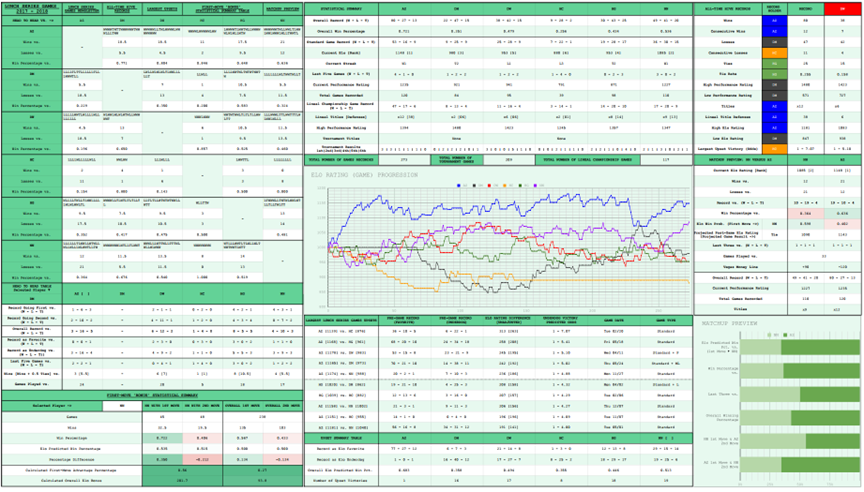
The snapshot above comes from a spreadsheet entitled Lunch Series Games, a term that I coined to represent the games my coworkers and I would play during breaks in the workday. Over the course of the year, we played a total of 273 games! I slowly expanded the spreadsheet into four workbooks: Hive Summary, Hive Elo, Hive Tournaments, and Hive Pictures.
Hive Summary is the image detailed above, consisting of a head-to-head table, detailed game records, Elo chart, and even a matchup preview. There is a table of all-time Hive records, including performance ratings and the largest upsets by odds.
Hive Elo provides the raw data of the spreadsheet on a game-by-game basis, along with the Elo table after each game.
Hive Tournaments lists the tournaments contested over the course of the year and links to the specific tournament overviews.
Hive Pictures shows photos of the penultimate positions of various games contested.
All in all, I spent a considerable amount of time developing the functions for this spreadsheet. I don’t believe I used any custom scripts in creating the spreadsheet, something that I would incorporate liberally in future spreadsheets. Though this spreadsheet dates back to 2017, I have already resorted to using my customary Courier New for the font.
Lasercut Hive Sets
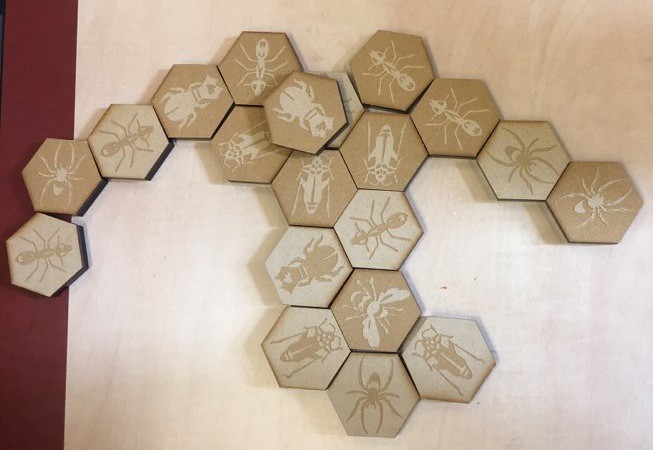
Over the course of the year, I used a laser cutter to construct a variety of Hive sets as gifts for family and friends. Probably it was on the order of a dozen or so – I lost track!
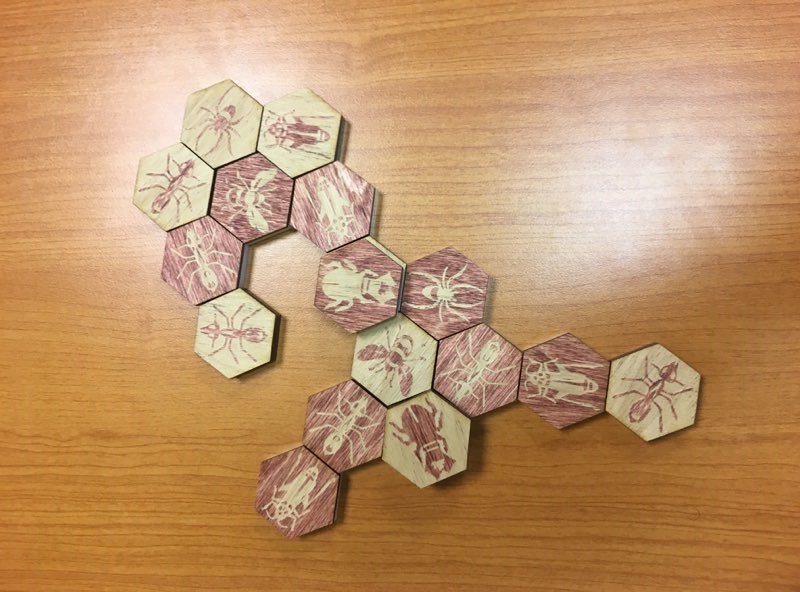
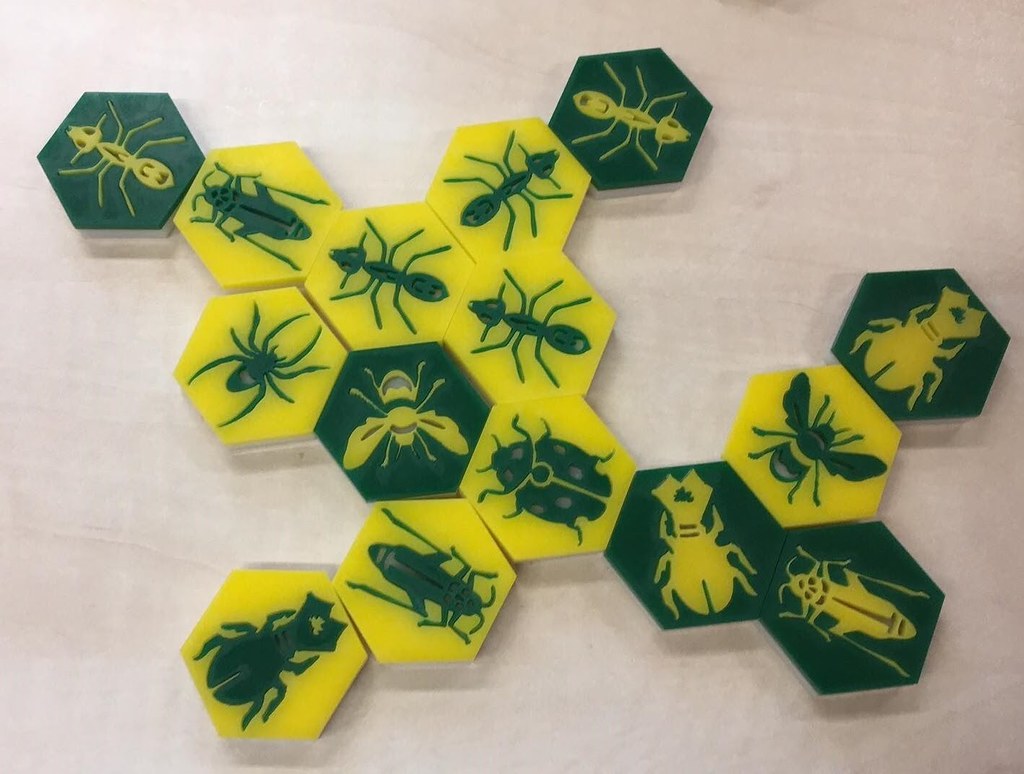
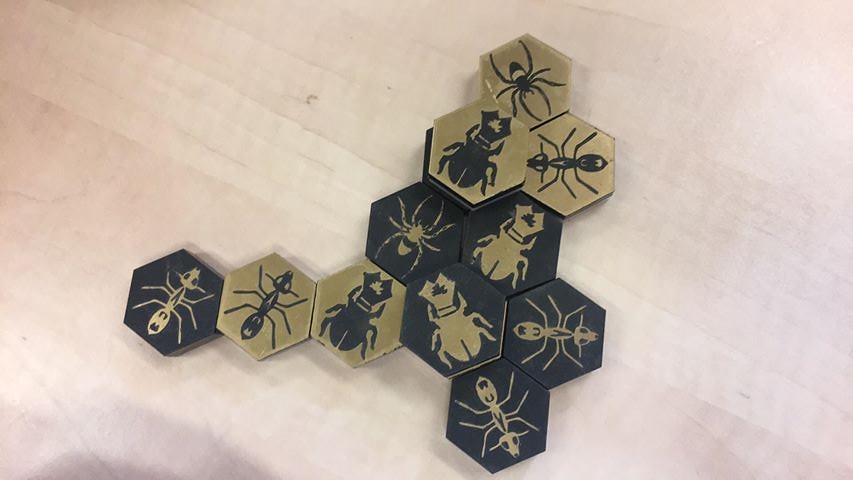
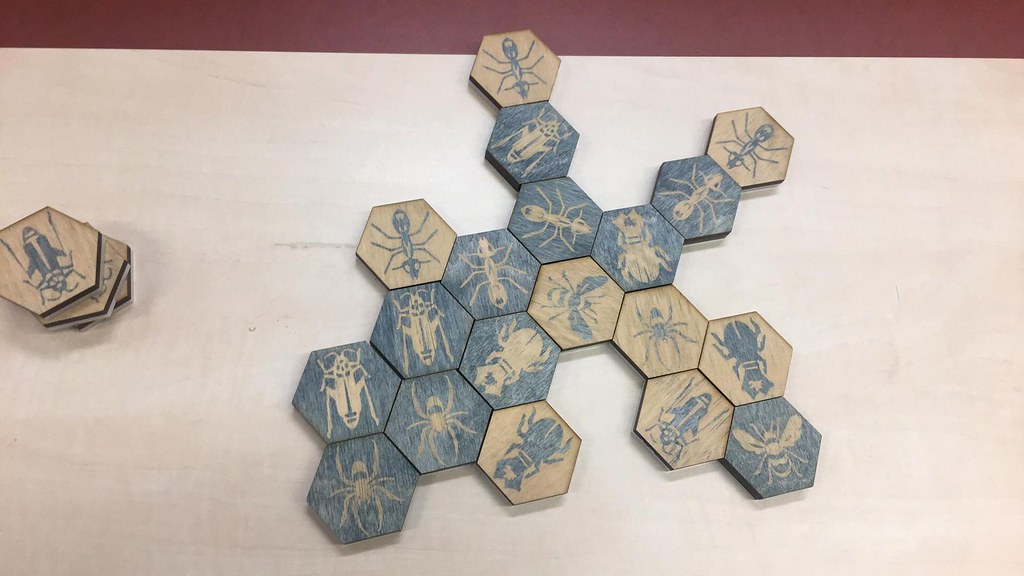
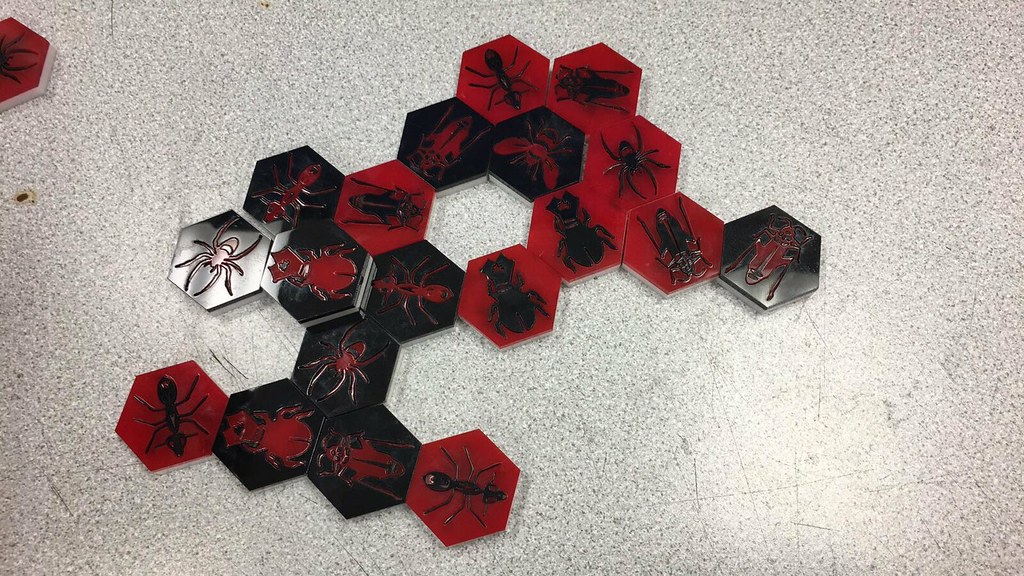
I made a few different styles of Hive sets. The first was using acrylic pieces, generally 1/8″ top over a 1/4″ acrylic base, with the base demarcating the player’s color. I also used acrylic inlay for certain sets. Another version involved a plywood top, in which I would stain the plywood before raster etching the design onto the surface; the player color depended on whether the laser rastered the foreground or background. Finally, I even made a couple of magnetic Hive sets. These were straightforward in design, consisting of three layers – top, middle, base – with the middle layer having a circular cutout to house the magnet. In all sets, either wood glue or superglue was used to assemble pieces.
The size of sets also varied from approximately 1 inch in piece edge length all the way to ~2.5 inches for a monster-sized set. I’ve hung on to a couple of sets with the remainder given away to inquisitive players.
Below are a few versions of the sets made, from photos included in the Hive Pictures workbook.
Hive Tournaments
Over the course of the year, there were a total of nine tournaments held – all with fanciful names and varying themes. Of these tourneys, I will highlight a few:
Seedy Greey Gamblers’ Tourney, in which betting on game outcomes played a role in tournament standings, the Glorious Garland Guerra Tourney, in which players were granted points based on captures of opposition pieces, and the Risky Random Roulette Tourney, in which pieces were drawn randomly from the bag.
All in all, organizing and participating in these Hive Tournaments was spectacular fun – below are the links to the PDF overview documents of the respective tournaments.
Hive Newsletter
Finally, it would be remiss for me not to mention the weekly newsletter I sent out to the participants of the Lunch Series Games. A few years ago, I sat down and compiled all the messages, which totalled more than 100 pages, most of it photos and diagrams – thankfully!
Reflection
Hive is an excellent addition to one’s board game armamentarium – it is easy to teach but hard to master, and it is one of the most portable games out there. I will confess that I have never played a game of Hive using official pieces, but I have logged a couple of hundred games with bootlegged ones. Don’t be like me, buy a set or two and try it out for yourself!
Below is the first set I made of MDF!