Project Timespan
A week in May 2018
Inspiration/Background
I have a particular fondness for asymmetric two-player games. One of my favorites is Blitz Bowl, a game I have written about extensively on this website (see here, here, here, here, and here). That being said, while Blitz Bowl only dates to 2018 (and its relative Blood Bowl to the 1980s), hneftafl, or Kings’ Table, has roots dating back to the 4th century. Imagine a group of Norsemen sitting around a fireplace, chanting and dancing in the background, a roast pig on a spit, playing this game.
Hneftafl Rules
At its core, hnefatafl is a simple game. It is played on a square board, commonly 11 x 11 (though sizes vary considerably), with an attacking side and a defending side. The defender controls the king, who is placed in the center of the board. Surrounding the king is a small retinue of defenders. The other player, the attacker, has surrounding attacking pieces starting on the boundary of the pitch. The attackers generally outnumber the defenders 2:1. One common version pits a king + 12 defenders against 24 attackers.
In terms of movement, all pieces move akin to the rook in chess, wherein they can move any number of spaces up/down or left/right, but they cannot jump over other pieces (including their own). A unique aspect of the game is in captures; opponent pieces are captured by sandwiching them between two of one’s own pieces. This has to be edge-to-edge, not vertex-to-vertex, forming a line. After capture, the piece is removed immediately from the game. Note that multiple pieces can be captured in one fell swoop!
To make things more interesting, there exist five special squares (typically). The center square can be thought of as the throne, with only the king able to occupy the spot. The four corner squares are also limited to only the king. In addition, these five squares help with captures for both sides.
The goal for the attacking forces is to surround the defenders’ king and capture it. In some variants, the king must be surrounded on all four sides. The goal for the defending forces is to break out with their king and escape to one of the corner squares.
Project Overview
When I made my version of this game in 2018, I had the luxury of access to Penn’s Fine Arts Clay Studio, having audited a couple of courses as an alum. Some other projects I made that year, posted on this website, include a Tintin project and a sculpture inspired by Escher.
Materials
Sculpture/Mould-Making
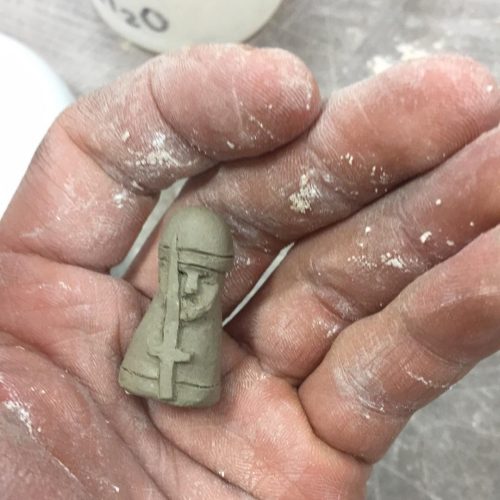
The most time-consuming (and fun) aspect of the project involved creating the master sculpt for the pieces. I sculpted the king separately, but the majority of the work would involve casting a total of 36 figurines to represent the soldiers.
The king and the soldier were both sculpted out of porcelain clay. I then waited for the pieces to dry and created a two-part plaster mould for the soldier. This would allow me to slip-cast the additional models.
I didn’t recall doing this, but looking back at the photos, I also sculpted shields for many of the models to add variety. All were equipped with a proper Viking sword.
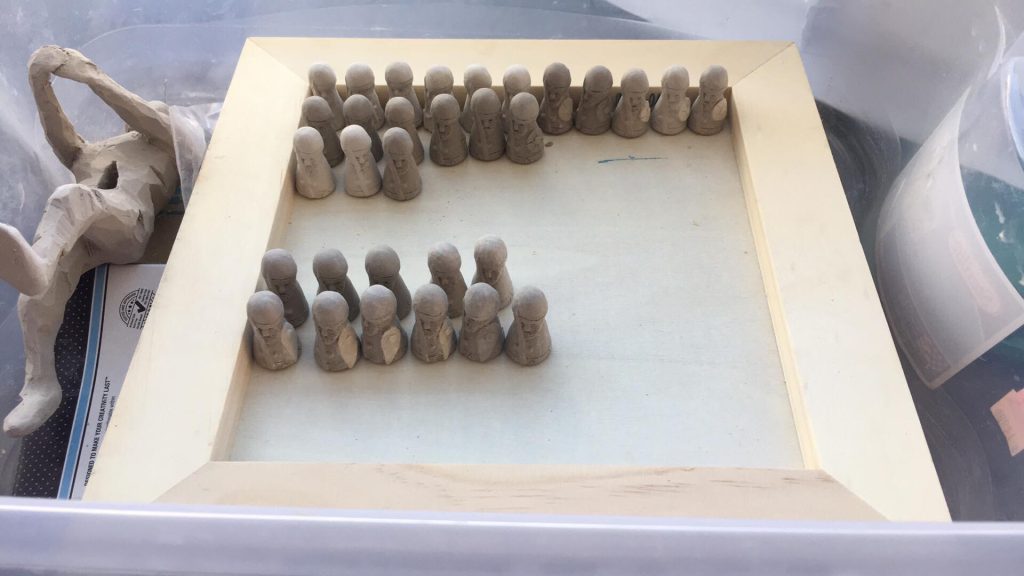
One can see the dried sculpture I made for the Escher project in the background of this photo. I was busy back then!
Bisque and Glazing
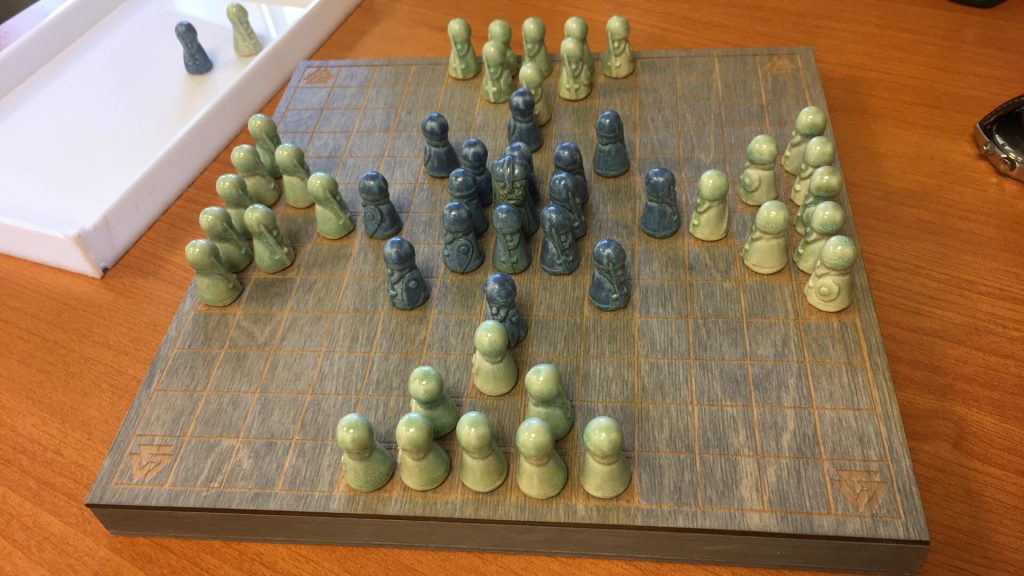
After casting all the models, the next step was bisque firing and glaze firing. I decided to go with simple, monochrome schemes: green glaze for the attackers and blue glaze for the defenders. I forgot how I glazed the models – I might have used a spray gun and a hood or dipped them individually. As usual for glazing, one must keep the bottom surface free from glaze lest it sticks to the shelf of the kiln.
Board and Storage
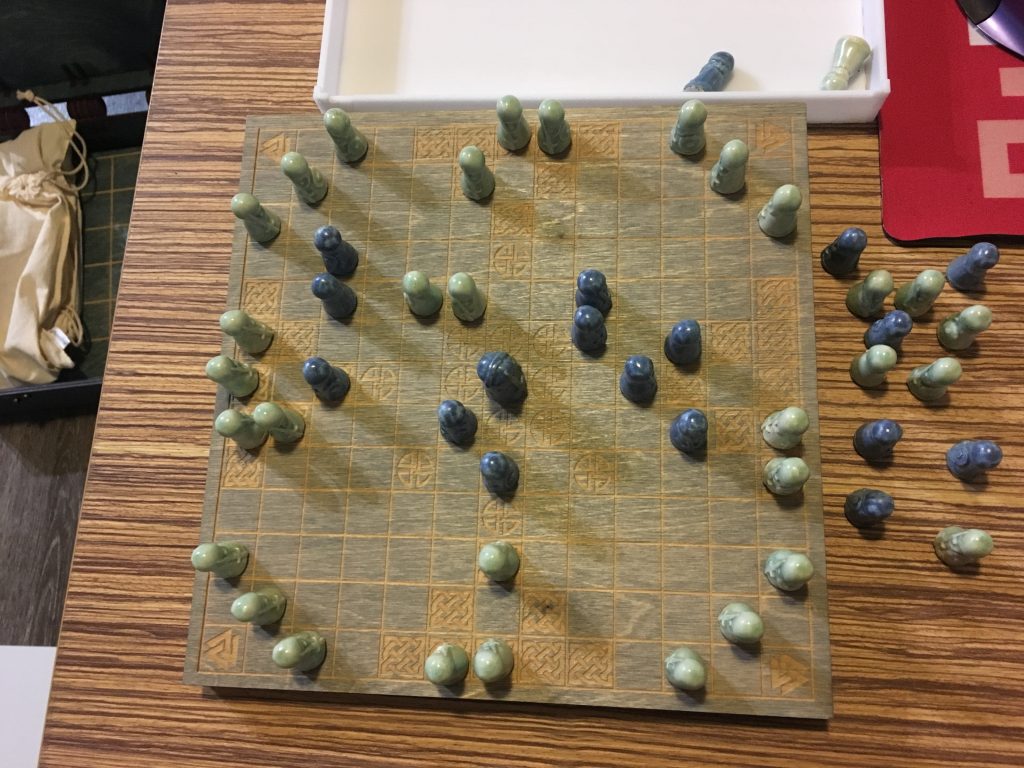
The board itself is a project panel from Blick Art Store. I found a couple of designs for the starting squares and corner tile. The panel was stained with a light blue stain. I then used a laser cutter to raster etch the gridlines and design onto the wood.
A laser cutter was used to vector cut 1/8″ white acrylic to serve as a box. To be honest, I am not quite sure how this all worked out, as from the photos, the storage box wouldn’t fit in the underbelly of the box, and there is no storage mechanism for the box to fit in place. Perhaps I never integrated the two together?
Lessons Learned & Improvements
This project went very smoothly, and I completed it in a matter of several days. That being said, I can find three gripes. The first involves technique and sculpture; looking back at the master model, I do think I could have spent a bit more time refining the details, though a rougher form does have an air of charm. Second, the board engraving does not contrast well with the stain, and it may benefit from perhaps a resin inlay. Finally, the storage solution is somewhat lacking. The acrylic box itself is constructed of white acrylic, which I find rather clashing with the ceramic / wood. It would be more elegant to build a box that has enough space to store all the game components.
Reflection
I no longer have hneftafl in my collection, having given it away years ago, but I hold a fond memory of the project. I have kept the plaster mould of the Norseman, so it should be fairly straightforward to recreate (sans the king, which would need to be resculpted). Perhaps I will revisit this project in the future. Hneftafal truly is a unique and well-designed game that has lasted the test of time. Try it out!